
Getting Started & Account Basics
-
The Transition to Everymail
- Why “Free” Email Is Usually Not Free
- Your transition to Everymail
- How can I subscribe to Everymail?
- How does the free trial work?
- Why is my email service being transitioned to Everymail?
- Why do I have to pay for email now?
- What happens if I don't subscribe during the free trial?
- Is my information shared or sold to third parties?
- Can I recover my email data if I don’t subscribe by the end of the subscription period?
- How does Everymail comply with data privacy laws?
- Does Everymail mine my data?
-
My Account
-
Forgot Your Password
-
Everymail on Every Device
Features & Functionality
-
Advanced Support
-
Everymail on the Web
- How to recognize genuine Everymail emails and avoid phishing
- Everymail on the Web
- Use 2-step Verification to secure your email account
- Downloading your Personal Data
- How to change your login password in webmail
- I can't login
- How do I log in to my email?
- Create a new folder
- Move an email to a folder
- Using search in Mail
- Archiving emails
- Storage Usage
- Mark as Spam/Not Spam
- Delete an email
- Setup your email signature
- Using sort to search
- Mark as Read/Unread
- How to spellcheck emails
- Adjust the size of text
- Enabling Conversations (Visually group all messages with their replies)
- Adjust your location, time zone and language settings
- Automatically save email addresses
- How to Auto forward emails
- Organize your email with folders
- Enter your contact information
-
Billing and Payments
-
Customize Everymail on the Web
- Customize your inbox
- Unified Mail
- Adding an existing email account to Webmail
- Customize your email with themes and backgrounds
- Organize your email using filter rules
- Using Inbox Categories to organize your incoming emails
- Choose your email layout view
- Configure your quick launch icons
- Enable dark-mode
- Customize your portal
-
Address Book
-
Calendar Management
-
Tasks Management
-
Email & File Encryption
Need more help?
Can't find what you're looking for? Our team is here for you.
Contact support
US Datacenter
Loading system status...
EU Datacenter
Loading system status...
Unified Mail
What is Unified Mail?
Manage all your email accounts from one inbox. Unified Mail lets you connect Gmail, Outlook, Yahoo, and other email accounts to Everymail, so you can read and manage everything in one place. No more switching between tabs, apps, or browsers.
Unified Mail requires that you set up additional email addresses as accounts in your Everymail Webmail first.
See: Adding an existing email account to Webmail
Unified Mail Details
-
Unified Mail lets you see all mail from the inboxes of multiple email addresses
- ONLY messages from INBOX folders are displayed in the Unified Mail folder (not messages that were previously moved to any other folder)
- Emails in the Unified Mail folder are marked with the email account's name, so you can see which email address they belong to
- Unified Mail can be enabled for one or more email addresses added to Webmail for your Everymail email address
- ⚠️CAUTION: Any action you take on any email message in the Unified Mail inbox folder (such as deleting) will affect that email message in the inbox of that email address, too.
How to Enable Unified Mail
👉 NOTE: You must have at least one additional email address added to your Everymail Webmail account before you can enable Unified Mail (How do I add accounts?)
- Click the
 Settings icon in the menu bar
 - Click All settings ...
- In the pop-up window, click Accounts on the left
- Click on Edit next to an email account you wish to enable
- Click the checkbox Use Unified Mail for this account
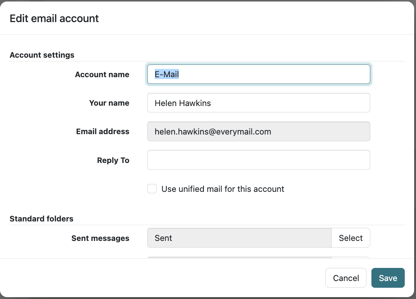
- Click Save
- Repeat steps 4-6 for each email address that you want to show up under the Unified Mail Inbox, including your main Everymail email address, if you want it to appear there.